
start with the choice you’re making
you’re shopping for something to keep beside your notebook. then you see the same ingredient described in a bedtime supplement and a focus product. reasonable question: why is it in both?
the ingredient name is only part of the answer. look at the complete formula, the amounts and what the product is for. l-theanine alone and l-theanine paired with caffeine are different choices.
workflow is a caffeine choice for work and study. every piece pairs 20 mg caffeine from guarana with 40 mg l-theanine. the amount is on the label, and both ingredients are already in the same gummy.
three questions that sound similar
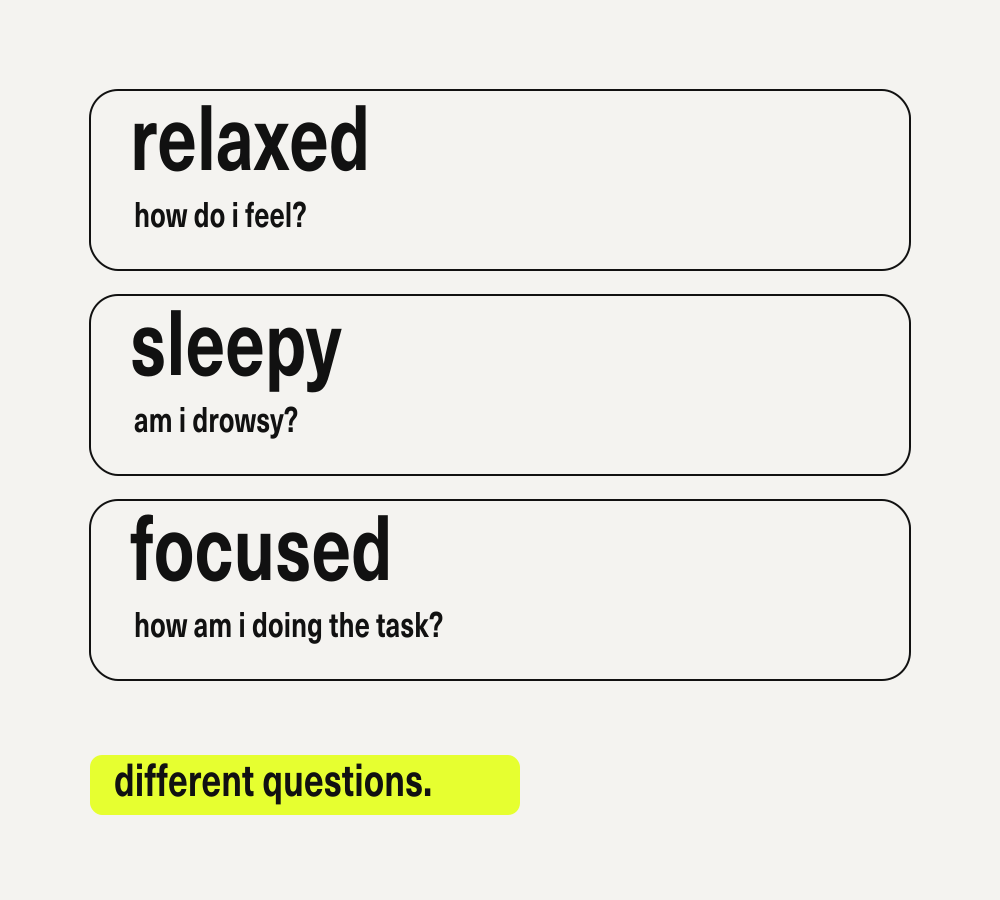
“relaxed,” “sleepy” and “focused” can get bundled into one vague feeling. research separates them.
an improvement on one measure does not tell you the result on the others. this is useful when reading a product page: “relaxation” is not automatically a promise of sleep, and “focus” should come with a more specific explanation.
| the question | what to look for |
|---|---|
| do i feel calmer? | a clearly described mood or relaxation measure |
| do i feel sleepy? | a sleepiness rating or a test of daytime vigilance |
| am i handling the task accurately? | correct responses on a defined attention task |
what the ingredient studies actually tested
brain activity at rest. nobre and colleagues compared a tea infusion containing 50 mg total l-theanine with water in healthy young participants: 16 received the drink and 19 were controls. eyes-closed eeg recordings at 45–105 minutes showed a greater increase in alpha-1 activity over time in the tea-infusion group. the authors discussed relaxed alertness; the tea-versus-water design does not isolate l-theanine from the rest of the drink. an eeg finding is a different measure from writing, studying or sleeping well. nobre et al., 2008
daytime sleepiness. ozeki and colleagues tested 200 mg l-theanine versus placebo in a randomized crossover study of healthy male daytime workers, with 13 participants in the morning session and 14 in the afternoon session. they reported no induced drowsiness on the subjective measure and no effect on the reported vigilance-task measures. that answers a daytime question in that sample, rather than guaranteeing how every person will feel. ozeki et al., 2008
attention with caffeine. giesbrecht and colleagues tested 40 mg caffeine + 97 mg l-theanine against placebo in 44 young adults. the combination improved task-switching accuracy and reported alertness; several other cognitive tasks did not improve significantly. testing took place at 20 and 70 minutes. there was no caffeine-only condition, so this study does not isolate theanine’s added contribution. giesbrecht et al., 2010
it also helps to be specific about “smoother.” in a study of 48 healthy adults, rogers and colleagues compared 250 mg caffeine, 200 mg theanine, the combination and placebo. theanine did not significantly change caffeine-related jitteriness or alertness. that is a reason to compare actual amounts rather than assume theanine cancels an effect you do not want. rogers et al., 2008
these are ingredient studies at their stated amounts, not trials of finished workflow gummies. together, they explain why researchers ask separate questions about relaxation, drowsiness and attention. they do not establish one universal “calm focus” feeling. the nobre and giesbrecht papers list unilever affiliations; two ozeki authors list taiyo kagaku affiliations.
the caffeine still counts
adding l-theanine does not subtract caffeine from a formula. choose the caffeine amount deliberately, including what you have already had and the time of day.
if you want no caffeine, choose a caffeine-free option. if you want a smaller labeled caffeine portion with the pairing built in, that is where workflow fits.
the pairing, in a piece you can count
one workflow gummy contains 20 mg caffeine + 40 mg l-theanine. the label serving is one gummy, with 40 gummies in each resealable pouch.
you get pineapple yuzu or blood orange mango, a vegan pectin-based gummy and 2 g sugar per piece. no brewing, no separate theanine product, no drink to carry back to the desk.
if you enjoy your coffee ritual and want to keep it, compare adding l-theanine separately with choosing a combined product. if you prefer the pairing in a fruit gummy, choose your flavor and follow the directions on your pouch.
[ TAKE IT WITH YOU ]
choose the full formula for the moment you’re in.
[ GOOD QUESTIONS ]
a little more clarity
is l-theanine only for bedtime?
no. it has also been studied during the day, alone and with caffeine, using measures such as daytime vigilance and task-switching performance. check the full formula and the question the research actually tested.
does “relaxation” mean it will make me sleepy?
the words describe different outcomes. the daytime study above did not find induced drowsiness in its participants. that result is more specific than a blanket promise about everyone’s response.
is workflow caffeine-free because it contains l-theanine?
no. each gummy contains 20 mg caffeine from guarana alongside 40 mg l-theanine. include that caffeine in your total.
what makes the combined gummy convenient?
both ingredients come in the same labeled piece, with two fruit flavors and no preparation. choose pineapple yuzu or blood orange mango; each pouch contains 40 gummies.
sources & further reading
original studies, product labels and references used in this guide.
written by workflow. follow the product label. send a question or correction.